Publications
Inflationary magnetogenesis beyond slow-roll and its induced gravitational waves
Authors: Bill Atkins, Debika Chowdhury, Alisha Marriott-Best, Gianmassimo Tasinato
Abstract: The origin of magnetic fields observed on both astrophysical and cosmological scales is a compelling problem that has the potential to shed light on the early Universe. We analytically investigate inflationary magnetogenesis in scenarios where a brief departure from slow-roll inflation—akin to mechanisms proposed for primordial black hole formation—leads to enhanced magnetic field generation with a growing power spectrum. Focusing on the Ratra model, we derive an analytic bound on the growth of the magnetic field power spectrum in this context, showing that the spectral index can reach dlnPB/dlnk=4.75 during the growth phase. This growth enables amplification from cosmic-microwave-background-safe large-scale amplitudes to values of astrophysical relevance. We further compute the stochastic gravitational wave background sourced by the resulting magnetic fields, incorporating their rich spectral features. Under suitable conditions, the induced signal exhibits a characteristic frequency dependence and amplitude within reach of future gravitational wave observatories, providing a distinctive signature of this mechanism and a specific class of templates for upcoming gravitational wave searches.
Publication location: Phys.Rev.D 112 (2025) 6, 063534 – Published 15 September 2025 - DOI: https://doi.org/10.1103/btjz-pqgv - preprint -https://arxiv.org/abs/2507.01772
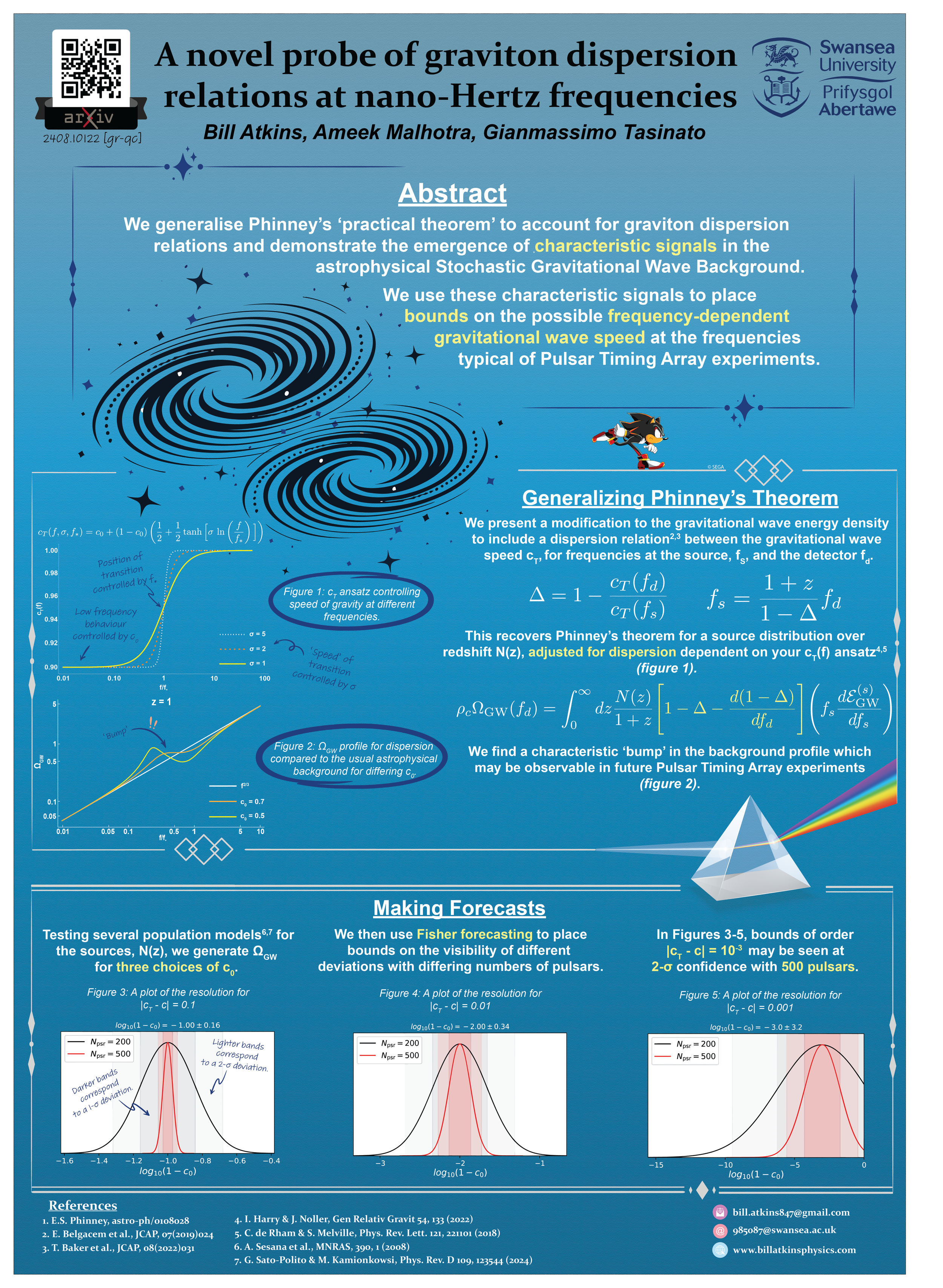
A novel probe of graviton dispersion relations at nano-Hertz frequencies
Authors: Bill Atkins, Ameek Malhotra, Gianmassimo Tasinato
Abstract: We generalise Phinney's 'practical theorem' to account for modified graviton dispersion relations motivated by certain cosmological scenarios. Focusing on specific examples, we show how such modifications can induce characteristic localised distortions, bumps, in the frequency profile of the stochastic gravitational wave background emitted from distant binary sources. We concentrate on gravitational waves at nano-Hertz frequencies probed by pulsar timing arrays, and we forecast the capabilities of future experiments to accurately probe parameters controlling modified dispersion relations. Our predictions are based on properties of gravitational waves emitted in the first inspiral phase of the binary process, and do not rely on assumptions of non-linear effects occurring during the binary merging phase.
Publication location: Phys.Rev.D 110 (2024) 12, 12 - Published: 9 December, 2024 - DOI https://doi.org/10.1103/PhysRevD.110.124018 - preprint - https://arxiv.org/abs/2408.10122
Hidden conformal symmetries for black holes in modified gravity
Authors: Bill Atkins, Gianmassimo Tasinato
Abstract: We determine hidden conformal symmetries behind the evolution equations of black hole perturbations in a vector-tensor theory of gravity. Such hidden symmetries are valid everywhere in the exterior region of a spherically symmetric, asymptotically flat black hole geometry. They allow us to factorize second order operators controlling the black hole perturbations into a product of two commuting first order operators. As a consequence, we are able to analytically determine the most general time-dependent solutions for the black hole perturbation equations. We focus on solutions belonging to a highest weight representation of a conformal symmetry, showing that they correspond to quasi-bound states with an ingoing behaviour into the black hole horizon, and exponential decay at spatial infinity. Their time-dependence is characterized by purely imaginary frequencies, with imaginary parts separated by integer numbers, as the overtones of quasi-normal modes in General Relativity.
Publication location: Phys. Rev. D 108, 104070 – Published 30 November 2023 - DOI: https://doi.org/10.1103/PhysRevD.108.104070 - preprint - https://arxiv.org/abs/2311.03860
Conference Attendance
2025
February 13th - STAMP Lectures
Invited talk: “Why Love vanishes in a Black Hole.”
Location: Higgs Centre for Theoretical Physics
June 10th - June 13th - COSMOFondue
Talk presented: “Using Machine Learning to disentangle the Stochastic Gravitational Wave Background”
Location: University of Geneva, Geneva, Switzerland
December 15th - December 17th - Annual Theory Meeting
Location: Durham University, UK
December 17th- December 18th - YTF 2025
Location: Durham University, UK
October 21st - October 25th - COSMO’24
Poster Presentation: “A novel probe of graviton dispersion relations at nano-Hertz frequencies”
Location: Kyoto University, Japan
December 16th - December 18th - Annual Theory Meeting
Location: Durham University, UK
December 18th- December 19th - YTF 2024
Talk presented: “A Novel Probe of graviton dispersion relations at nano-Hertz frequencies.”
Location: Durham University, UK
2023
March 20th - March 31st - Theoretical Aspects of Astroparticle Physics, Cosmology, and Gravitation
Location: The Galileo Galilei Institute For Theoretical Physics, Florence, Italy
August 29th - September 9th - BUSSTEPP 2023
Talk presented: “Why does Love vanish in a Black Hole?”
Location: University of Liverpool, UK
8th November - UKCOSMO
Location: Queen Mary University of London, UK
December 12th - December 14th - Annual Theory Meeting
Location: Durham University, UK
December 14th- December 15th - YTF 2023
Talk presented: “What can Hidden Conformal Symmetries tell us about Black Holes?”
Location: Durham University, UK
2024
April 16th - April 17th - BritGrav 2024
Location: Queen Mary University of London, UK
May 14th - May 16th - EuCAPT 4th Annual Symposium
Location: CERN, Geneva, Switzerland